A book that changed my life, and the lives of countless artists, entrepreneurs, and aspirants pursuing a higher calling is The War of Art by Steven Pressfield. I read it at least once per quarter.
In my view, its impact can be attributed to the boldness it has to define the enemy. In that book, Pressfield's definition of the enemy is capital-R Resistance - the intangible, invisible universal force which acts against the creative impulse of the artist’s soul. It relentlessly and ruthlessly sabotages, negotiates, coerces, seduces, and rationalizes every reason in the world to not do your fucking work, not birth your art into the world.
Self doubt? Fear? Distraction? Ego? These are all the malevolent tendrils of Resistance. While its defiance against our growth and fulfillment feels insidious, Resistance itself is not an inherently evil or moral force. Rather, it is a relentless, omnipresent, and predictable force of nature, consistent, indifferent, and impersonal as the force of gravity.
The War of Art is immeasurably popular insofar as it touches on a seemingly universal human experience. We have a calling, aspirations to higher forms of expression and actualization, and yet even in the absence of literal enemies or obstructions, we feel as though something is holding us back. We know that we grapple with it — and are often defeated by it because of its amorphous, intangible nature. We are being bested without even knowing it.
In Scandinavian folklore, the Nøkken, also known as Neck or Näcken, is a shape-shifting water spirit, often depicted as an evil entity that dwells in lakes, rivers, and ponds. The Nøkken is especially known for luring people, particularly children and travelers, to drown by enchanting them with haunting, beautiful music, often played on a fiddle. In various tales, the Nøkken would take on different forms, such as a handsome man, a horse, or a log floating in water, to attract victims close to the water’s edge before dragging them to their watery grave.
One of the most notable and chilling aspects of the Nøkken myth is that the only way to ward off or defeat this creature is to speak its name aloud. This act disrupts its power, breaking its spell over anyone enthralled by it. According to the myth, naming the Nøkken out loud strips it of its supernatural influence, as the name brings it out of its mysterious, ethereal realm and forces it into a form that humans can recognize and confront.
By naming Resistance — or any other inner adversarial struggle, be it a fear, an inner critic, or other self-sabotaging tendency—we pull it out from the shadows and give it a form that we can confront, examine, and understand. Naming demystifies and “embodies” an adversary, making it easier to acknowledge, strategize against, and eventually overcome it.
Resistance powerfully personifies a universal struggle, the inner battles that many of us face individually. Yet, we also grapple with collective and societal forces—ephemeral, undefined enemies—that dominate our spirits through their unseen influence.
A year ago, I was going through a curriculum of books, podcasts, and articles designed by my friend and mentor, Erick Godsey. One of the articles, Meditations on Moloch was prescribed a means to define and understand the Enemy that is as existentially threatening to the human species as it is to ourselves individually:
The Zero-Sum Game Dynamic.
Alan Ginsberg’s poem on Moloch opens the article:
What sphinx of cement and aluminum bashed open their skulls and ate up their brains and imagination?
Moloch! Solitude! Filth! Ugliness! Ashcans and unobtainable dollars! Children screaming under the stairways! Boys sobbing in armies! Old men weeping in the parks!
Moloch! Moloch! Nightmare of Moloch! Moloch the loveless! Mental Moloch! Moloch the heavy judger of men!
Moloch the incomprehensible prison! Moloch the crossbone soulless jailhouse and Congress of sorrows! Moloch whose buildings are judgment! Moloch the vast stone of war! Moloch the stunned governments!
Moloch whose mind is pure machinery! Moloch whose blood is running money! Moloch whose fingers are ten armies! Moloch whose breast is a cannibal dynamo! Moloch whose ear is a smoking tomb!
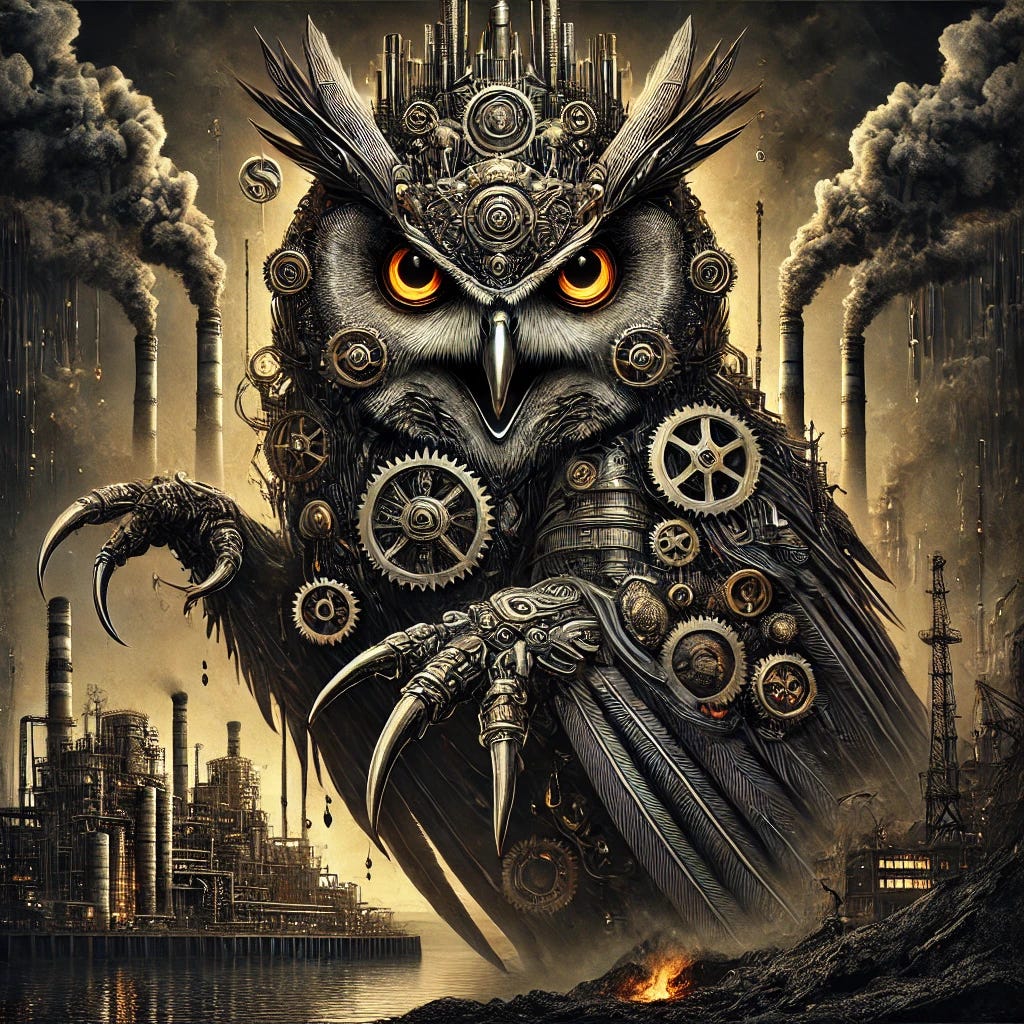
Moloch whose eyes are a thousand blind windows! Moloch whose skyscrapers stand in the long streets like endless Jehovahs! Moloch whose factories dream and croak in the fog! Moloch whose smoke-stacks and antennae crown the cities!
Moloch whose love is endless oil and stone! Moloch whose soul is electricity and banks! Moloch whose poverty is the specter of genius! Moloch whose fate is a cloud of sexless hydrogen! Moloch whose name is the Mind!
Moloch in whom I sit lonely! Moloch in whom I dream Angels! Crazy in Moloch! Cocksucker in Moloch! Lacklove and manless in Moloch!
Moloch who entered my soul early! Moloch in whom I am a consciousness without a body! Moloch who frightened me out of my natural ecstasy! Moloch whom I abandon! Wake up in Moloch! Light streaming out of the sky!
Moloch! Moloch! Robot apartments! invisible suburbs! skeleton treasuries! blind capitals! demonic industries! spectral nations! invincible madhouses! granite cocks! monstrous bombs!
They broke their backs lifting Moloch to Heaven! Pavements, trees, radios, tons! lifting the city to Heaven which exists and is everywhere about us!
Visions! omens! hallucinations! miracles! ecstasies! gone down the American river!
Dreams! adorations! illuminations! religions! the whole boatload of sensitive bullshit!
Breakthroughs! over the river! flips and crucifixions! gone down the flood! Highs! Epiphanies! Despairs! Ten years’ animal screams and suicides! Minds! New loves! Mad generation! down on the rocks of Time!
Real holy laughter in the river! They saw it all! the wild eyes! the holy yells! They bade farewell! They jumped off the roof! to solitude! waving! carrying flowers! Down to the river! into the street!
I shudder, and feel nauseous reading it. As I read through the article on zero-sum game dynamics that we’re playing out in society at large, I want to rip my hair out — it seems so fucking stupid from a “God’s eye view”, and yet the realities of how sticky the trap is are irresistable.
In a nutshell, our collective enemy is multipolar traps, where without broad coordination strategies, people feel forced into making harmful decisions out of a need for self-preservation.
Think “race to the bottom” where companies cut wages or environmental protections to stay competitive. Though owners and workers might prefer fair/sustainable conditions, competition pressures them to sacrifice these values just to survive.
"This fucking sucks and I hate it, but if I don’t do it, I’m kinda fucked”.
It’s everywhere, a feature (bug) of our capitalist system.
Parts of me really WANTS to resonate with libertarian philosophy—mainly as a reaction against what feels like the inevitable authoritarian tyranny that might arise from pursuing an idealized, collectivist vision of utopian ‘equality.’
But I would feel dissonant trying to defend libertarianism in a world still driven by zero-sum dynamics. Moloch would thrive in a free market, exploiting human nature and the lure of short-term competitive gains to undermine the broad cooperation needed to avoid a race to the bottom.
I’m not downplaying the importance of personal freedoms—the highest values in libertarian philosophy. However, regulation and government oversight, through laws and enforcement mechanisms, act as substitutes for a shared collective myth that encourages broad cooperation. Without this anchor, falling for Moloch’s multipolar traps feel inevitable… even moreso than we already are with some of the safeguards we’ve attempted to put up in our current system.
It seems paradoxical that achieving ultimate personal and independent freedom requires ultimate cooperation, or an ethos that prioritizes the collective good as the highest ideal (yet in a way that transcends the limitations of flawed systems like communism or centralized power structures).
The urgency of creating this unifying mythos becomes more daunting when we consider the exponential development of AI, and society’s tendency towards utility maximization. Artificial intelligence can be used to improve the efficacy and sophistication of artificial intelligence, the crescendo of which has often been represented by technological singularity in various sci-fi scenarios.
To quote the article:
Once a robot can do everything an IQ 80 human can do, only better and cheaper, there will be no reason to employ IQ 80 humans. Once a robot can do everything an IQ 120 human can do, only better and cheaper, there will be no reason to employ IQ 120 humans. Once a robot can do everything an IQ 180 human can do, only better and cheaper, there will be no reason to employ humans at all, in the unlikely scenario that there are any left by that point.
What might a hyper-intelligent robot god have to say about zero-sum game dynamics? Would we, as a species, willingly allow ourselves to be guided and organized by a quantum supercomputer optimized for the greatest possible outcomes? And if we refused, could we be headed toward a technological apocalypse where robotic overlords "cleanse" our species after deeming us an obstinate, inefficient, zero-sum-playing biomass blight on the planet?
I’m being tongue-and-cheek here, but Matrix-style robot overlords or not, the fate of our species really seems to depend on mass-scale cooperation and coordination. There is strength in numbers. And we need an army to defeat an enemy as insidious, cunning, and ruthlessly evil as that fiend, Moloch.
How do you organize an army? Cooperation, coordination, and above all else, you need a strong unifying purpose, a share ethos that will be the glue that holds it all together.
I'm still trying to crack the code on how to do this. My business, QX, has figured out the first iterations through helping coaches build online communities on Skool, where their business' monthly recurring revenue is contingent on how strong of a leader they are, how much they can build a culture that feels like a haven of belonging, and how engaged, involved, and cared about the members become.
Inspired by the same curriculum that Meditations on Moloch was on, I created my own 12-module curriculum on becoming a community leader that was intended for myself, but was made public to anyone who felt the spark to take up the responsibility to do this.
There are definable enemies to those who would attempt to step up as leaders and organize this coordinated cooperation against evil in the world. I believe the principle enemy of most individuals in the modern day is fragmentation of attention, and the inability to concentrate. Said bluntly, we're all fucking around on our phones and our minds flitter about like squirrels on coke, ruminating, and doing anything BUT concentrating on an intended aim, doing deep work for long periods of time.
The best mythic personification I've seen of this invisible enemy is the demon king in Buddhist mythology, Mara, as described in Erick Godsey's excellent article, The Four Faces of Mara.
The article is worth a read in itself (and if you'd rather, there's a podcast on it here), but here's a quick synopsis of our enemy:
The force our concentration is contending against has been translated into four distinct mental tendencies by science/Buddhist tradition:
- Mindlessness
- Mindwandering (Specifically rumination)
- Multi-Tasking
- Reactivity
Mindlessness is what happens when our awareness drifts into autopilot—when we scroll Instagram with no memory of why we opened it, or reread a page only to realize our eyes moved but our mind didn’t. It’s the soul falling asleep at the wheel while the body keeps driving.
Psychologically, it’s a lapse in the brain’s executive attention system—a moment when the light of consciousness flickers out and habit takes over.
It’s the spell of boredom—the dull ache of an untrained attention seeking stimulation instead of presence. Distraction still remembers its purpose but gets lured by shiny things; mindlessness forgets there was ever a purpose at all. To awaken from it is to take up the sword of awareness and cut through the fog, returning again and again to the living moment where meaning dwells.
Mindwandering is what happens when the mind slips its leash and drifts into daydreams, memories, and fantasies—an endless mental scroll feed.
It’s not evil in itself; in fact, this wandering faculty is the soil of creativity, the place where imagination germinates. But in the modern West, it’s been colonized by anxiety and nostalgia. We don’t wander through meadows of insight; we loop through echo chambers of regret, comparison, and “what if.”
Half our waking life is spent there, studies show—and this mental wandering doesn’t just reflect unhappiness; it creates it.
The Default Mode Network—the brain’s idle hum when we’re not focused—has become our psychic background radiation, humming with unresolved stories and unprocessed pain.
Mythopoetically, mindwandering is the Siren’s song: the inner voice that lures consciousness off its course with sweet fragments of memory and fear.
Multitasking is the illusion (IE, the lie we tell ourselves) that we can divide the light of consciousness into fragments without dimming it. In truth, the mind can’t juggle; it only flickers.
What we call “multitasking” is rapid task-switching, a kind of cognitive strobe light that resets our focus every few seconds and drains our capacity for depth.
It’s why we check our messages while half-listening to a friend, or skim five tabs while “writing.”
The research is brutal: each switch slows us down, weakens memory, and blinds us to how much worse we’ve become at thinking. And the great amplifier of this delusion—the new temple of distraction—is the Internet, especially social media.
These digital labyrinths reward shallow engagement and constant novelty, sculpting a generation trained to sip from a thousand streams but never drink deeply from one.
Multitasking is the dance of Mara’s mirror hall, where attention splinters into infinite reflections and the self forgets which one is real. To escape, one must learn the ancient discipline of single-pointedness—the art of doing one thing as if it were everything.
What Buddhists would call Dukkha—not merely “suffering,” but Reactivity is the reflexive, unconscious ways we respond to life through old emotional blueprints.
It’s the invisible choreography of our childhood attachments, playing out through every anxious thought, defensive argument, or self-punishing spiral.
Dukkha is the internal momentum that keeps us reacting instead of responding, grasping instead of seeing. In modern life, it looks like the shame that tightens when a text goes unanswered, the envy that stirs while scrolling, the guilt that flares when we rest.
It’s not pain itself, but our relationship to pain—the way we tighten around it. The West calls it trauma, conditioning, maladaptive patterning. The Buddha called it the human condition.
The method of deliverance is not escape but mastery: the cultivation of concentration so steady, so luminous, that reactivity dissolves in awareness like salt in clear water.
Concentration is the sword we wield against these nephelim principalities which consume the humany species with suffering. Sharpening our focus is imperative to literally everything we do, from our businesses, to our health, to our relationships. And holy shit is it it ever difficult to try to convince people to start meditating.
(If you're sufficiently inspired by this article and want to learn though, you can find a month free for my favorite meditation app, Waking Up by Sam Harris here)
One of the hugest things I "trojan horse" into my business coaching practice is the cultivation of attention and the capacity to monotask. I do this by organizing near daily focused co-working sessions with my community called Dharma Sprints (also coined by Erick Godsey - I'm kind of obsessed with his work, if you haven't picked up on it by now).
A dharma sprint is a form of active meditation that trains your concentration while also producing work that moves the needle forward in your life. The structure is simple:
- Decide on the next "right action" that you are going to take
- Choose the duration of the sprint
- Define the constraints
- When the timer is set, you either do the task or you meditate (breathe and focus on the sensations of breathing, for simplicity's sake)
- When finished, write an honest review of how it went
The review is the coolest part. It adds the element of progressive iteration, helping you develop a "practice within the practice"; maybe you interrupted yourself because you had to go up and get a glass of water. Next time, before your sprint, you'll have a glass of water next to you before you start. Maybe you couldn't resist checking your phone within the parameters; next time, you can delete all the tempting apps, and go put your phone, turned off, in a drawer, in another room (I have literally had to lock my phone in a timed safe at various phases of my journey).
I did a dharma sprint to finish this article, which I had to write today, on Sunday, because I didn't have time in the week to sit down and complete it. When I first started experimenting on monotasking in my workflow, I was distraught to realize that my capacity to focus on one task at a time was so injured, I could barely get through 20 minutes of efforts before getting bored and overwhelmed by the urges to task switch. Over time, and with honesty in my reviews and reflective iterations, I built up my capacity to do 2-4 hours of dedicated work uninterrupted.
This capacity is how I built my business to multiple six figures, grew a community of over 1,000 coaches who I'm teaching to scale their businesses to $12-25k/month or more, reached the top 5% earners on Skool, and am doing the most fun, fulfilling work that I've ever done in my entire life.
Have the courage to name your enemies and stare them straight in the face. Know that the greatest weapon you have against them is your concentration, and start to sharpen the sword. Realize that you can't do it alone, and start finding allies who will join you in the Great War. And trust God that He will show you the path as you become the warrior of your own life who can defeat this overwhelming Goliath.
Luv,
A